If you have been told you have uterine fibroids and need surgery, one question usually comes up quickly: should it be a laparoscopic myomectomy or an open surgery? Both procedures remove fibroids while keeping your uterus safe, so you can still plan a pregnancy in the future. The difference lies in how the surgeon reaches the fibroids, how quickly you recover, and which types of fibroids each method handles best.
No single procedure is the best choice for every woman. Your decision depends on your fibroids’ size, number, and location, your general health, and whether you plan to become pregnant. This guide describes both procedures in straightforward language, compares their differences, and helps you identify which might suit your needs.
What Are Fibroids and What Is a Myomectomy?
Fibroids are non-cancerous growths that form in or around the muscular wall of the uterus. Some women may not experience any symptoms. Others experience heavy or prolonged periods, pelvic pain, pressure on the bladder, frequent urination, bloating, or difficulty getting pregnant.
When fibroids cause troubling symptoms or affect fertility, doctors may recommend a myomectomy. This operation removes the fibroids without removing the uterus. It is different from a hysterectomy, which removes the entire uterus. For women who want to keep the option of becoming pregnant, myomectomy is usually the preferred surgical choice.
A myomectomy can be done in two main ways:
- Laparoscopic myomectomy – a minimally invasive “keyhole” surgery
- Open myomectomy – also called abdominal myomectomy or laparotomy
Laparoscopic Myomectomy: Keyhole Surgery With Faster Recovery
Laparoscopic myomectomy is a minimally invasive way to remove fibroids. Instead of one large cut, the surgeon works through a few small openings in the abdomen.
How It Works
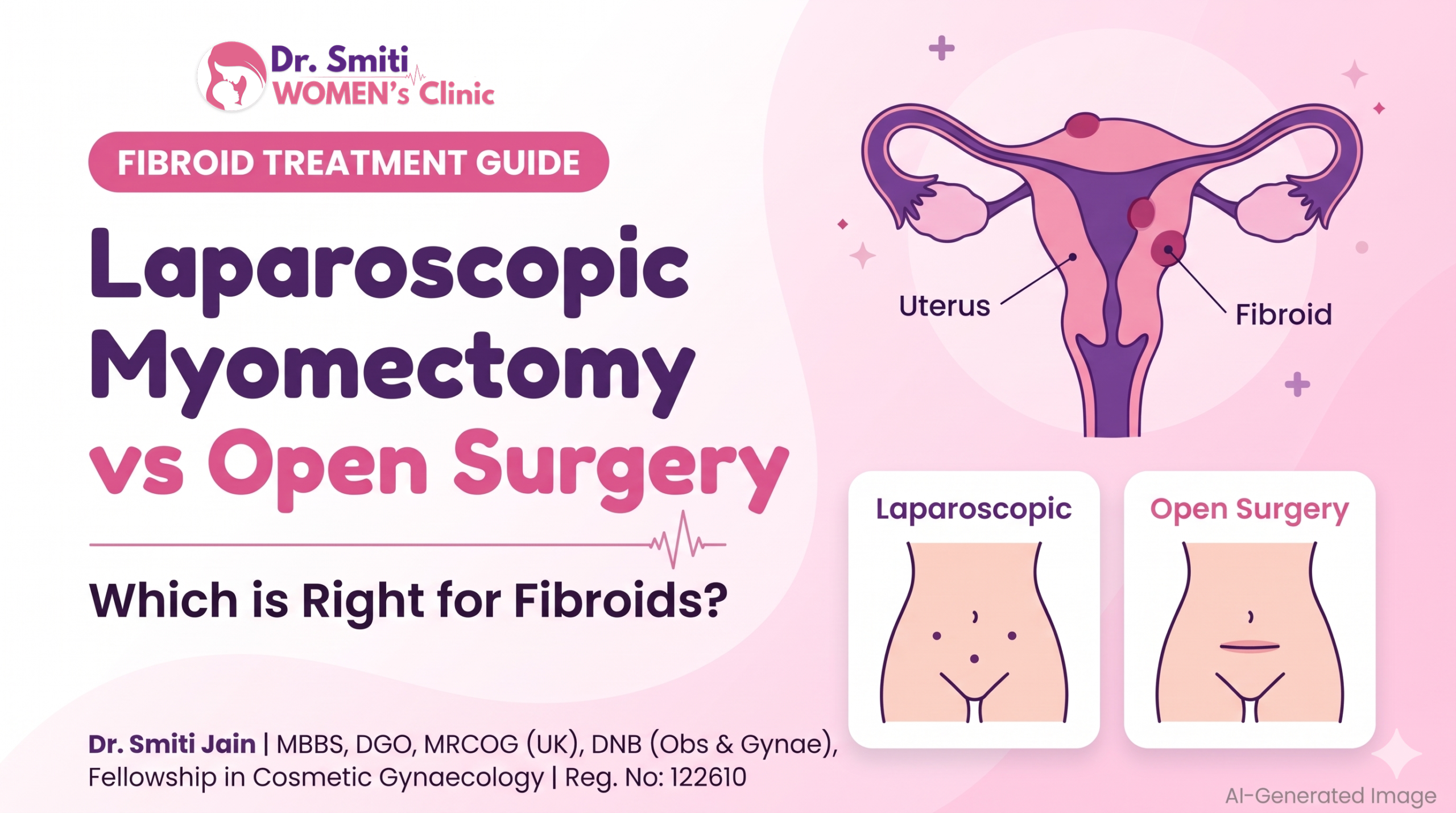
- The surgeon makes 3 to 5 small cuts, each about 0.5 to 1 cm long.
- A laparoscope (a thin tube with a high-definition camera) is inserted to show the uterus on a monitor.
- Special long instruments are used to locate and remove the fibroids.
- Larger fibroids may be cut into smaller pieces so they can be taken out through the small openings.
- The uterine wall is carefully stitched and repaired from inside.
Advantages
- Smaller scars and better cosmetic results
- Less blood loss and lower chance of needing a blood transfusion
- Less pain after surgery
- Shorter hospital stay, often just 1 day
- Faster recovery, with most women back to normal routine in 2 to 4 weeks
- Lower risk of wound infection
Open Myomectomy: Full Access for Complex Cases
Open myomectomy, also called abdominal myomectomy, is the traditional method of removing fibroids. The surgeon makes one larger cut in the lower abdomen, usually along the bikini line, and reaches the uterus directly.
How It Works
- A single cut of about 10 to 12 cm (sometimes larger) is made in the lower abdomen.
- The surgeon can directly see and feel the uterus.
- Fibroids are removed, often whole, without cutting them into small pieces.
- The uterine wall is repaired layer by layer with careful stitching.
Advantages
- The surgeon can feel the depth and firmness of each fibroid, and can find small fibroids that scans may have missed
- Strong, layer-by-layer repair of the uterine wall, which matters for future pregnancy
- More efficient for removing a large number of fibroids in one surgery
- Lower chance of fibroid tissue being left behind in complex case
Many people think open surgery is an “old” method. In reality, it remains one of the most reliable and trusted techniques when the case is complex. Open does not mean outdated.
Laparoscopic Myomectomy vs. Open Surgery: Key Differences
The biggest difference between the two is the size of the cut and how the surgeon reaches the uterus. Here is a simple side-by-side comparison:
| Factor | Laparoscopic Myomectomy | Open Myomectomy |
| Type of surgery | Minimally invasive (keyhole) | Traditional abdominal surgery |
| Incision | 3–5 small cuts of 0.5–1 cm each | One larger cut of 10–12 cm or more |
| Scarring | Small, barely visible scars | Larger scar, usually along the bikini line |
| Blood loss | Lower | Higher; transfusion more likely |
| Pain after surgery | Usually less | Usually more, but well controlled with medicines |
| Hospital stay | About 1 day | Usually 3–5 days |
| Recovery time | 2–4 weeks | 4–6 weeks (up to 8 in some cases) |
| Infection risk | Lower | Higher, due to the larger wound |
| Best for | Fewer fibroids, under 8–10 cm, not deeply embedded | Large, many or deeply embedded fibroids |
| Fibroid removal | Often cut into small pieces | Can be removed whole |
| Surgeon’s access | Through a camera on a screen | Direct view and touch of the uterus |
| Uterine repair | Precise stitching, needs advanced skill | Layer-by-layer repair with direct control |
In short, laparoscopy offers comfort and speed, while open surgery offers access and control for difficult cases.
Safety, Fertility and Future Pregnancy
Which One Is Safer?
Both surgical procedures are generally safe when carried out by an experienced surgeon. For suitable patients, laparoscopy is often considered the safer option because of smaller wounds, less bleeding, lower infection risk and fewer adhesions (internal scar tissue).
However, safety depends on choosing the right method for the right case. Trying to remove very large or deep fibroids through keyhole surgery can increase risks and may leave some fibroid tissue behind. In such situations, open surgery is the safer and more complete choice.
What About Pregnancy?
Both types of myomectomy can improve the chances of pregnancy when fibroids have been affecting fertility. A few points to keep in mind:
- Strong uterine repair is key. For large or deep fibroids, open surgery allows the surgeon to rebuild the uterine wall carefully, layer by layer.
- Waiting period. Doctors usually advise waiting a few months after surgery before trying to conceive, so the uterus can heal fully.
- Mode of delivery. Depending on how deep the cuts in the uterus were, a caesarean delivery may be recommended in future pregnancies.
- The risk of uterine rupture during pregnancy is low, but it may be slightly higher after extensive surgery on the uterine wall.
If you are considering pregnancy in the future, inform your gynaecologist before surgery. It helps them choose the approach that protects your uterus best.
How Doctors Decide: Which Is Right for You?
The choice of surgery is never random. It is based on your body, your fibroids and your goals. Before recommending an approach, your gynaecologist will review your ultrasound or MRI reports, symptoms and medical history, and consider:
- Number of fibroids
- Size of each fibroid
- How deep they sit in the uterine muscle
- Overall size of the uterus
- Fibroids situated close to the bladder, intestines, or blood vessels.
- Past abdominal surgeries
- Your general health, including conditions like obesity
- Your plans for future pregnancy
Laparoscopic Myomectomy May Be Right for You If:
- You have one or a few fibroids of small to moderate size
- The fibroids are easy to reach and not deeply embedded
- You want a quicker return to work and daily life
- You prefer smaller scars and less pain after surgery
Open Myomectomy May Be Right for You If:
- You have one very large fibroid
- You have many fibroids spread across the uterus
- The fibroids are deep inside the uterine wall
- Your uterus is significantly enlarged
- Complete removal and strong uterine repair are the top priority
For example, a woman with one medium-sized fibroid may do very well with laparoscopy. A woman with several large fibroids is often safer with open surgery. The decision is personal, not generic.
The Best Surgery Is the One That Fits Your Case
Laparoscopic myomectomy and open myomectomy are not “new versus old” methods. Both are trusted ways to remove fibroids while saving the uterus. Laparoscopy offers smaller scars, less pain and faster recovery for suitable cases. Open surgery offers better access, complete removal and strong uterine repair when fibroids are large, many or deep.
The right choice comes from a careful evaluation of your fibroids, your health and your future plans. If you are dealing with fibroid symptoms or have been advised surgery, book a consultation at our clinic. Our team will assess your reports, explain your options clearly, and help you choose the safest and most effective treatment for you.
Frequently Asked Questions
1. Will my fibroids come back after myomectomy?
Myomectomy removes the existing fibroids, but new ones can grow over time, especially in younger women. Regular follow-up check-ups help detect any new growth early.
2. Can a laparoscopic surgery be changed to open surgery during the operation?
Yes. If the surgeon finds that the fibroids are larger, deeper or more numerous than expected, they may switch to open surgery for your safety.
3. How long should I wait to get pregnant after a myomectomy?
Most doctors advise waiting a few months so the uterus can heal properly. Your gynaecologist will suggest the right time based on your surgery.
4. Is laparoscopic myomectomy painful?
There is some discomfort after surgery, but it is usually less than after open surgery and is easily managed with medicines.
5. When can I return to work?
After laparoscopic myomectomy, most women return to work in 2 to 4 weeks. After open surgery, it usually takes 4 to 6 weeks, depending on the nature of your work.


