
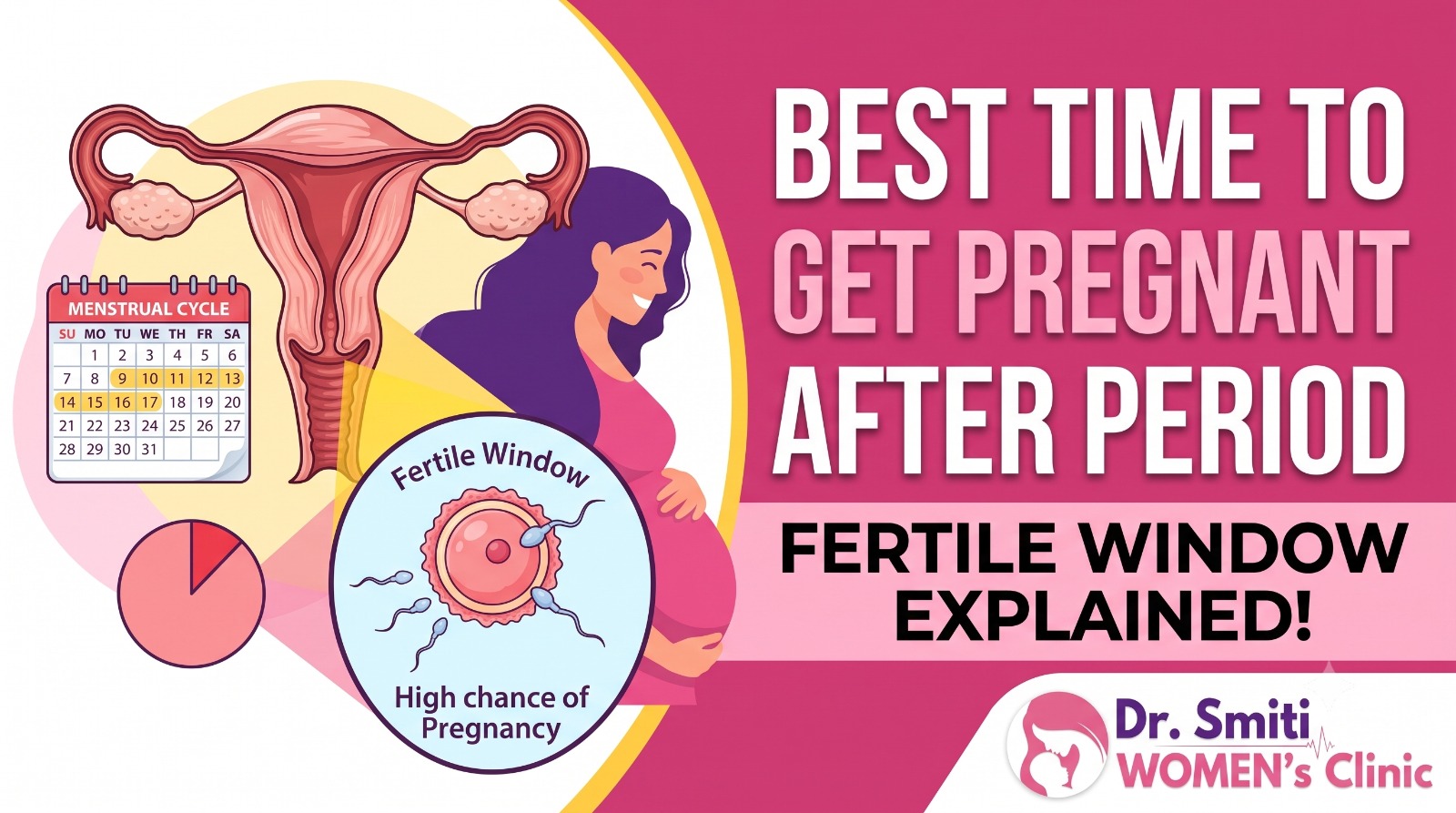
Trying to conceive can feel confusing when you’re unsure about the best time to get pregnant after your period. While many people assume that ovulation always happens on Day 14, the truth is that your fertile window depends on your individual menstrual cycle. Understanding when ovulation occurs—and how long sperm and the egg can survive—can help you identify the days when pregnancy is most likely.
In this guide, we’ll explain how your menstrual cycle works, when ovulation may occur after your period, how to calculate your fertile window, and which physical signs can help you identify your most fertile days. Whether you have a regular or slightly irregular cycle, understanding your body’s natural fertility signals can make timing intercourse more effective when you’re trying to conceive.
Understanding Your Menstrual Cycle First
Before you can figure out the best time to get pregnant after your period, it helps to understand what’s actually happening inside your body each month.
- Day 1 of your menstrual cycle is the first day of period bleeding — not the day your period ends.
- The follicular phase begins on Day 1 and continues until ovulation, while your ovaries develop and mature an egg.
- Ovulation is the release of that mature egg — this is the main event that makes pregnancy possible.
- After ovulation comes the luteal phase, which continues until the start of your next period.
Most fertility advice online assumes every woman has a textbook 28-day cycle, but cycle length can range anywhere from 21 to 35 days and still be considered normal. That’s exactly why the same generic “Day 14” advice doesn’t work for everyone.
How Long After Period Do You Ovulate?
This is often the main source of confusion. Ovulation is not counted from when your period ends — it’s counted backward from your next period.
As a general guideline, ovulation occurs approximately 14 days before the next period, no matter how long your cycle lasts. So:
| Cycle Length | Ovulation Occurs Around | Fertile Window |
| 21 days | Day 7 | Days 4–8 |
| 24 days | Day 10 | Days 7–11 |
| 28 days | Day 14 | Days 11–15 |
| 30 days | Day 16 | Days 13–17 |
| 32 days | Day 18 | Days 15–19 |
| 35 days | Day 21 | Days 18–22 |
So how many days of ovulation after period should you expect? If you have a short cycle (21–24 days), ovulation can happen just a few days after your period ends — sometimes even while light spotting is still tapering off. If your cycle runs longer (32–35 days), there’s a wider gap between your period ending and your fertile window opening.
Why Pregnancy Chances After Period Depend on More Than the Calendar?
Under favourable conditions, sperm may live inside the female reproductive tract for up to 5 days, whereas the released egg remains viable for only 12 to 24 hours. This is the biological reason the fertile window spans about 6 days rather than a single day:
- The 5 days before ovulation — because sperm already present can wait for the egg
- Ovulation day itself — the single highest-probability day
This is also why the probability of pregnancy after period isn’t zero even if you don’t have sex on the exact day of ovulation. Well-timed intercourse in the days leading up to ovulation is often just as effective as intercourse on ovulation day itself.
Can You Get Pregnant Right After Your Period?
Yes — and this surprises a lot of women. If you have a short cycle and a longer period, your fertile window can begin only a few days after bleeding stops. For example, in a 24-day cycle with a 6–7 day period, ovulation can occur around Day 10, meaning the fertile window starts almost immediately after menstruation ends. In these cases, assuming you’re “safe” right after your period is a common and avoidable miscalculation.
How to Calculate Your Own Fertile Window?
Instead of relying on a generic chart, you can estimate your personal ovulation window using your own cycle data:
- Track your cycle length for 2–3 months, counting from the first day of one period to the first day of the next.
- Subtract 14 days from your average cycle length — this estimates your ovulation day.
- Count back 5 days from that date — this marks the start of your fertile window.
- Add 1 day after the estimated ovulation date to account for egg lifespan — this marks the end of the window.
This calculation gives a reasonable estimate for women with fairly regular cycles. If your cycles vary by more than a few days month to month, calendar-based tracking becomes less reliable, and physical fertility signs or ovulation predictor kits become more useful.
Physical Signs That Ovulation Is Approaching
Your body gives fairly consistent signals as ovulation nears. Learning to recognise these can improve timing accuracy far more than counting days alone:
- Cervical mucus changes — becomes clear, stretchy, and slippery, often compared to raw egg white. This is usually the most reliable at-home sign of approaching ovulation.
- Mild one-sided pelvic pain (Mittelschmerz) — a dull ache on the side of the ovary releasing the egg.
- Slight rise in basal body temperature (BBT) — a small increase of about 0.2–0.5°C after ovulation, useful for confirming patterns over several cycles.
- Increased libido — a natural hormonal response around the fertile window.
- Breast tenderness or fullness — linked to the hormonal surge around ovulation.
- A positive ovulation predictor kit (OPK) — detects the LH surge that triggers ovulation, usually 24–36 hours before egg release.
No single sign is foolproof on its own, but tracking two or three together gives a far clearer picture than the calendar method alone.
Tips to Improve Your Chances of Conceiving
- Have intercourse every 1–2 days during your estimated fertile window rather than trying to pinpoint one “perfect” day.
- Track cervical mucus changes alongside cycle length for a more accurate window.
- Use ovulation predictor kits if your cycle length varies.
- Maintain a healthy weight, balanced diet, and limit alcohol and smoking, all of which affect hormonal regulation.
- Manage underlying conditions like PCOS or thyroid disorders with proper medical care, since these directly affect ovulation timing.
- If pregnancy hasn’t occurred after 12 months of regular, unprotected intercourse, or after 6 months if you’re over 35, fertility evaluation is usually recommended.
Conclusion
The ideal time to become pregnant following your period differs for every woman. Your fertile window depends mainly on your cycle length and the timing of ovulation, which generally occurs about 14 days before your next period. Because sperm can survive for up to 5 days and the egg remains viable for about 12–24 hours, having intercourse during the days leading up to and around ovulation can give you the best chance of conception.
Monitoring your menstrual cycle, cervical mucus, ovulation signs, and using ovulation predictor kits can help you pinpoint fertile days more accurately. If your cycles are irregular or you’re struggling to conceive, a healthcare provider can guide you toward the right approach. Understanding your fertile window is an important first step toward planning a healthy pregnancy.


